How to Study Chess Openings (and Actually Remember Them)
You know how it goes. You sit down with the Italian Game, watch a couple of videos, play through the line five times. Three days later your opponent plays something on move three that wasn't in the video. Or it was, but you can't remember what comes next.
It usually isn't your memory. You studied the wrong things, in the wrong way.
Here's how to study openings so they stay in your head. First the general rules, then how it works on Ochess. Everything below is on the site.
How many openings do you need?
Fewer than you think. To start with, three are enough:
- one opening as White;
- one answer to 1.e4;
- one answer to 1.d4.
Other first moves come up far less often, and early on you can meet them with general principles: take the centre, develop your pieces, castle.
The usual mistake isn't knowing too few openings. It's knowing lots of them, five moves deep each. Like learning five words in four languages: you can say hello everywhere, and then there's an awkward silence.
One opening twelve moves deep beats four openings five moves deep.
When should you start learning openings?
If you've only just learned how the pieces move, openings can wait. At that level games are decided by blunders, not theory. You can play a perfect Italian and drop your queen on move ten.
So tactics come first, and the best way to improve them is solving puzzles. Ours are grouped by opening: the tactics are the same, but the positions come from the games you'll actually be playing. Puzzles have ratings, and your own puzzle rating shows whether your tactics are getting better.
Try it right here. Three easy puzzles from our Italian Game set, all with White. Your opponent moves first, then it's your turn.


 8

 7


 2
 a b c
 e 1 h 7 2 a b e g 8 7 3 2 a c f g
Solved all three in a minute? Great. Didn't? No problem: there are a couple of thousand more in the Italian set, from very easy to very hard.
Solve puzzles →A good sign it's time for openings: you keep getting similar positions and don't know what to do in them. Or you keep losing the same way in the first ten moves. That means you already have an opening. You just haven't learned it yet.
Study what your opponents actually play
This is the big one, and hardly anyone writes about it.
Opening books and videos are made by strong players, and they cover what strong players play. Your opponents play something else.
An example. The Italian Game: 1.e4 e5 2.Nf3 Nc6 3.Bc4. In the books Black answers 3...Bc5 or 3...Nf6. The move 3...h6 barely gets a mention there, and fair enough: it doesn't develop a piece.
8 6 2 a b c d e 1 h Except your opponents haven't read the book.
I looked at rated Lichess games from the last 12 months (blitz, rapid and classical) and checked how often Black answers 3.Bc4 with 3...h6.
| Average rating of the players | Of games that reached 3.Bc4, 3...h6 was played in |
|---|---|
| 1400–1599 | 17% (about one game in six) |
| 1800–1999 | 7% |
| 2000–2199 | 2.6% |
| 2200 and above | 0.5% (one game in 200) |
At 1400 it's the third most common reply, after 3...Nf6 and 3...Bc5. If you play the Italian, you'll run into it all the time. And you won't find a ready answer in the book.
These are Lichess ratings. The same players usually sit lower on Chess.com: 1400–1599 on Lichess is roughly 1000–1250 on Chess.com, comparing blitz with blitz.
That's why our courses are built for a rating. Every opening comes in five versions, for 1400, 1600, 1800, 2000 and 2200, and the opponent's moves in each version come from games at that level.
And you don't always have to do the whole course. The most recently updated courses come with a study plan that splits the chapters into three groups. Main: the replies you'll meet most often, so start there. Common: the next layer. Rare: rare replies, for later. Switch on Main lines and the course shows only what matters most. The other courses get the plan as they're updated.
Ideas first, then moves
Moves without an idea are the first to go. If you understand why White prepares c3 and d4 in the Italian, you'll rebuild the move order yourself even after you've forgotten it.
Where to get the ideas:
- opening guides: plans for both sides, typical positions and common questions (here's the Italian Game guide);
- comments in the course: when the opponent's move has a note, the course stops and shows it;
- traps: the tricks people set in your opening and how not to fall for them;
- puzzles: positions from games in your opening where there was a winning move.
To be honest about the comments: there are fewer of them than we'd like. We're writing more right now, so not every move has a note yet.
Play the moves, don't read them
Recognising a move when you see it on screen is easy. Remembering it yourself, with no prompt, is much harder. And in a game you need the second.
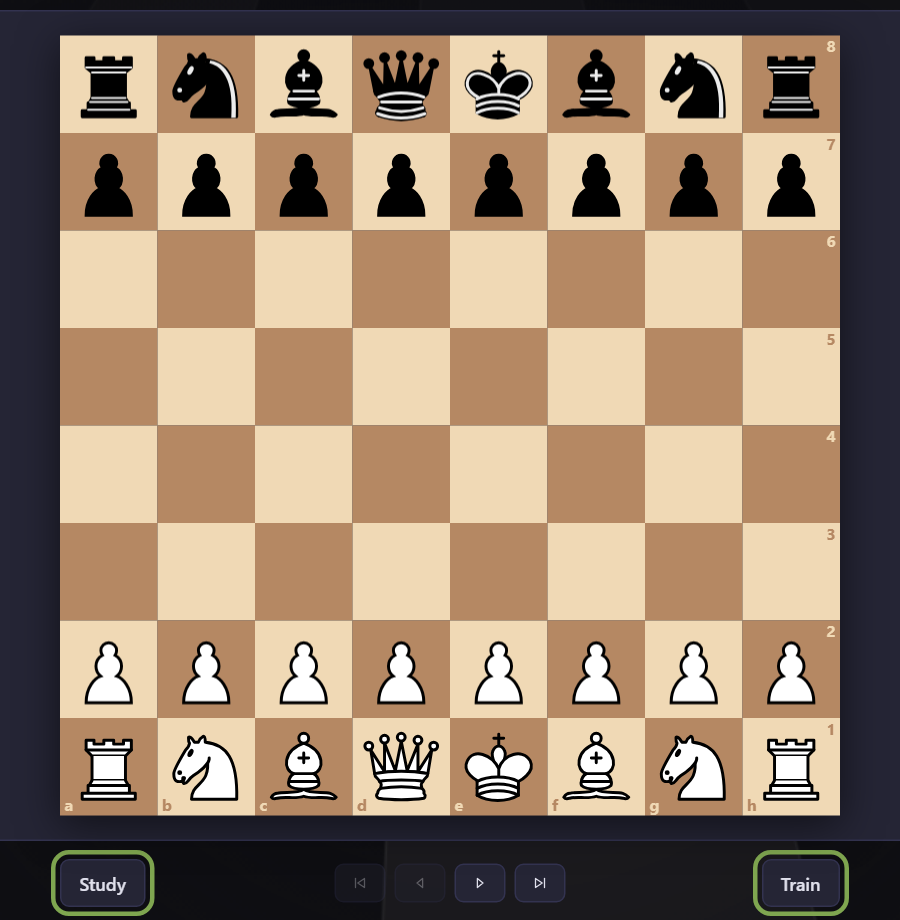
That's why each course chapter has two modes. The buttons are under the board: Study on the left, Training on the right.
Study. You play your side, and the card on the right names the move to make. The opponent answers by itself. The point is to play the line through and see where it leads. If you like, you can turn on arrows on the board in the settings.
Training. The same line, but with no prompts, and the move list is hidden. First pick which chapters to drill. You can shuffle the order so you don't just remember the lines by their sequence.
You have to remember the move yourself. Play the wrong one and the square turns red, then try again or take a hint. Mistakes and hints are counted.
Traps work the same way. Each one has Study, where the move is named, and Train, where you play the trap from memory. Every Train run is counted, so you can see how many times you've played it.
Review at the right time
You can learn a line in an evening. You can't keep it without reviewing: your brain nods politely and wipes it a week later. But drilling everything every day doesn't work either. It gets old fast.
What works is spaced repetition: you review a line just as it starts to fade. After the first run, again in 4 hours. Then after a day, 3 days, a week, two weeks, a month, three months and six months.
Get through a chapter in Training with no mistakes and no hints, and the next review moves further out. Take a hint, and the interval stays the same. Make a mistake, and the chapter comes back in 4 hours.
You don't have to keep track. The site knows which chapters are due and reminds you with the bell. Press Review now and the queue builds itself. Reviews work when you're signed in.
Check your own games
After a game, look at where your line ended. Who left it first, you or your opponent?
If your opponent played a move you hadn't prepared, it's worth looking at. If you forgot a move yourself, that chapter is due for review.
On the site, that's what My Games is for. It pulls in your games from Lichess and Chess.com, groups them by opening and shows where you left theory.
A simple plan
- Every day, 10–15 minutes. First the chapters that are due. Then one new chapter: Study, then straight into Training.
- After each batch of games: open them and see where your line ended.
- Once a week: one trap from your opening and a few puzzles from it.
Here's one of those daily sessions, step by step, with a screenshot of each screen.
What a course won't do
A course can't cover every move your opponent might play, or it would be thousands of lines long. Rare replies are left out on purpose. When your opponent leaves the course, you're on your own, and that's where the ideas from the guide and the general principles come in.
And a course won't replace playing. An opening sticks when you play it against real people. Even if, as usual, they play 3...h6.
Pick an opening and your rating on the courses page. You can try one line of any course without signing up. While the open beta lasts, the rest is free too. You just need an account.
Pick a course →