The Martian Gambit: unsound, and still hard to meet
1.e4 c6 2.d4 d5 3.Nc3 dxe4 4.Nxe4 Bf5 5.Ng5 Bg6 6.N1f3 h6 7.Ne6!?
The Martian Gambit is a knight sacrifice in the Classical Caro-Kann, popularised in 2024 by the Bulgarian CM Volen Dyulgerov — Witty_Alien online — as a follow-up to his Alien Gambit, which Black had started dodging with a change in move order.
Straight to the point: the gambit is unsound. White gives up a whole piece and does not even get a pawn for it. Every engine hands Black a clear plus. That is where the theory ends — and where the reason people actually play it begins.


 8
8  6
6 
 2
2  a
a  c
c  d
d  e f 1 h
 The key position, after 8.Ne5. Push the pieces around: the panel shows what people actually play here and how they score, per rating window, and the engine is one click away.
How the position happens
Up to move seven everything looks normal. Black plays the Classical with 4...Bf5; instead of the usual 5.Ng3 White puts the knight on g5, eyeing f7 and e6. Then N1f3, and Black chases the knight with the most natural move on the board, 6...h6.
White is not retreating. 7.Ne6 attacks the queen on d8 and the bishop on f8, so 7...fxe6 is both principled and, in practice, the only move anyone plays: about 90% at every rating band from 1200 to 2500, and the sparser data below 1200 says the same. Declining is worse than it looks — after 7...Qd7 8.Nxf8 Kxf8 the material is back, the king has lost castling, and the engine reads +2.4 for White. Taking the knight is not the greedy option here; it is the only one.
Worth noticing: without 6...h6 there is no gambit. After 6...e6 the square is occupied, and in the other set-ups the sacrifice loses its point — the pawn stays on h7, the bishop always has that retreat, and Black's position has no holes. The gambit exists only because Black plays the move that suggests itself.
What the piece buys
Black is a knight up. In return White gets four things:
- A wrecked centre. The doubled e6/e7 pawns are frozen and get in the way of Black's own pieces.
- No f7-pawn. The a2–g8 diagonal is open, and e6, f7 and g6 have lost their pawn cover.
- A dead kingside. The bishop on f8 and the rook on h8 are out of the game, and castling short is awkward.
- The knight on e5. It dominates the centre and attacks the bishop on g6 — and the bishop cannot be defended. The pawn that would have covered g6 is the f7-pawn, and it is now standing on e6; the h-pawn is on h6, where it only guards g5; the rook on h8 does not see the square. So Nxg6 would just win the bishop, and Black has to move it — which is the fork the whole gambit is built around.
Plus the ideas Bc4 and Qh5 against the weakened light squares, which are unpleasant to calculate at the board with a clock running.
The engine agrees more than you would expect. A clean piece down should read about −3 — 7...fxe6 is a pawn capture, so White gets nothing material for the knight. After 8.Ne5 Stockfish says −1.5 at depth 24 — it prices White's compensation at roughly a pawn and a half. Unsound, yes. Free, no.
The fork: where the bishop goes
Three moves matter here, and they are the whole story of the gambit.
- 8...Bf5 — best. The bishop survives, the light squares near the king stay covered, and White is provoked into 9.g4, a move that blocks his own diagonals. Engine: −1.5.
- 8...Bh7 — the other sane move. The bishop goes somewhere safe and Black untangles. Engine: −1.3.
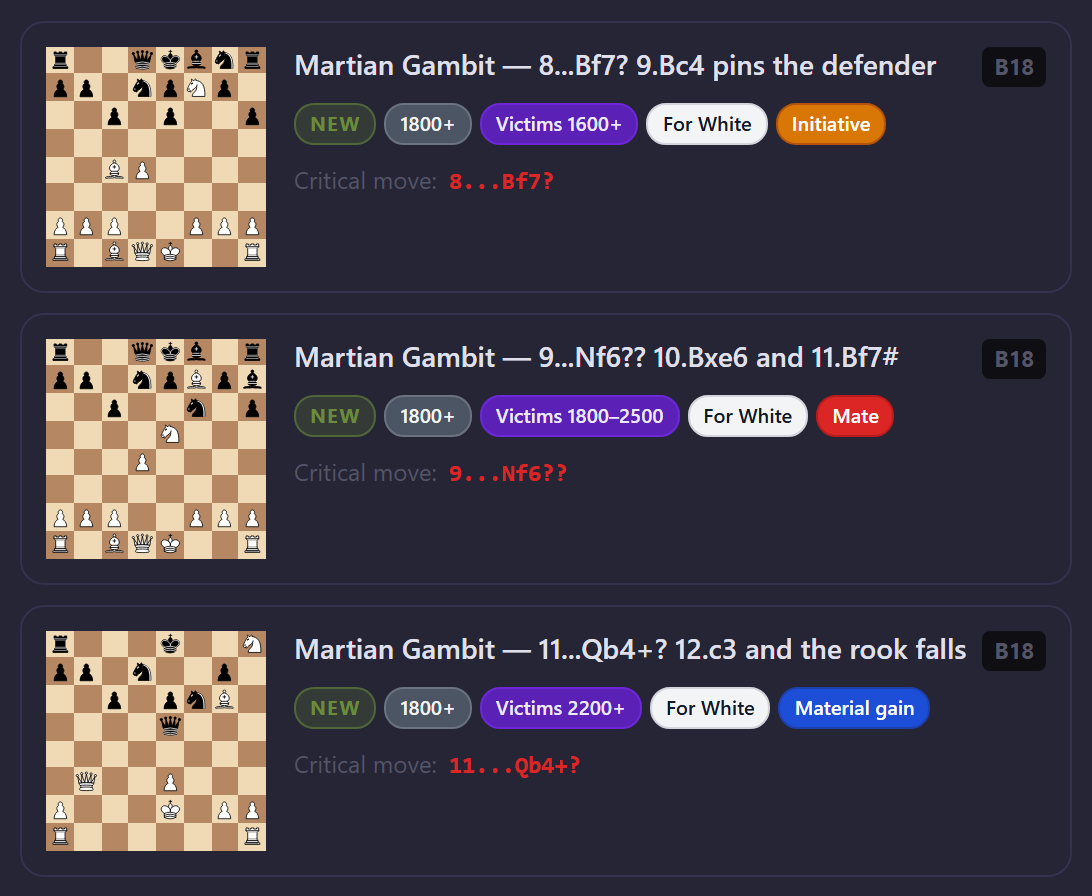
- 8...Bf7 — the practical mistake. The bishop steps onto the a2–g8 diagonal, 9.Bc4 pins it against the king, and Black's pieces tie themselves in knots. Engine: −0.6 — well over half of Black's advantage gone in one natural-looking move.
Now the part I did not expect when we measured it. Bf7 is not a beginner's move. The stronger the player, the more likely they are to find it:
It makes sense once you look at what Bf7 is trying to do. It defends the weak e6-pawn and offers a trade of the bad bishop — a strong player's instincts, not a weak one's. The trap is built out of good habits.
Even the engine has to work for it. Give Stockfish this position at depth 18 with a clean hash and it reads +0.2 for White — a piece down. Only around depth 24 does it come back with −0.6. If it takes an engine that long to see Black's advantage, the ten seconds you have at the board are not going to be enough.
Knowing the move is not the same as surviving it
Here is the other half, and it is the reason "just play 8...Bf5" is not the whole advice. This is how White scores after each of the three bishop moves:
- After 8...Bf7 (the mistake): White scores 55% at 1400, 65% at 1800, 69% at 2200.
- After 8...Bf5 (best): White scores 64% at 1400, 65% at 1800 — and only at 2200 does it fall to 53%.
- After 8...Bh7: White scores 64–67% at every rating.
Read the first two rows again. At 1400, Black does worse after the best move than after the mistake; at 1800 the two score exactly the same. The engine's verdict is real — it just does not reach the board until somebody knows what to do with an extra piece against an attack.
That is the honest shape of "this line is refuted". The refutation is a move; surviving the next twenty is a skill, and the skill arrives several hundred rating points later than the move does: the majority starts finding 8...Bf7 around 1600, and the defence only starts outscoring it at 2200.
What Black should actually do
Three principles, worth more than the variations:
- Do not get greedy. The extra piece is insurance, not the goal. Giving back the knight or the exchange for development and king safety is almost always right.
- Hold the light squares. Trading the light-squared bishop for a tempo is usually the concession after which the attack starts playing itself.
- Develop the kingside. Nf6, e6, Be7, castle — problem solved. While the king sits in the centre White has a game; after Black castles, he does not.
Survive the opening and Black is a piece up in a winning position. That is not a figure of speech — it is the result of essentially every game where the defence was found.
Should you play it yourself
Hard to recommend. It is not a repertoire opening: it does not survive a prepared opponent, and it does not survive a long time control.
Two things the numbers changed about the usual advice, though. The first is the rating ceiling. "It works up to about 2200" is not what the games say: at 2500 White still scores 66.8%, and 68% of players there walk onto f7 with the bishop. What actually happens at the top is that the gambit stops being played at slow controls — of those 2500-rated games, strip out bullet and nine remain.
The second is the time control itself. At the fork, 61% pick the losing bishop move in bullet, 63% in blitz, 56% in rapid and classical. Thinking time buys almost nothing here, because the move is not a slip — it is a plan. The real difference is volume: 9,900 bullet games at this position against 950 rapid and classical ones.
And one argument against that has nothing to do with chess: the gambit is popular. Enough videos, enough views, and it has landed in the preparation of plenty of Caro-Kann players. Surprise is the gambit's main asset, and it is being spent.
Where this shows up on the site
Both gambits are in the trap catalogue, line by line, with the rating range where players genuinely fall for each one — measured the way described here, at the decision point, per rating window, rather than guessed. That is where the tags come from, and they are not always where you would expect: 8...Bf7 is filed under victims 1600+, while the Alien Gambit's 7...Bg4 is a trap for players under 1600. Same family, opposite audiences.

The bottom line
The Martian Gambit is a clean example of the gap between the objective and the practical evaluation. Objectively White is just losing a piece. Practically, Black has to find a specific move in an unfamiliar position with the king in the centre — and then keep finding moves for another twenty.
For Black the takeaway is short: remember 8...Bf5 (or 8...Bh7), and then spend a minute on what comes after it. Below 1600 the second half is the part that decides the game.